Articles
Creative Kitchen Interior Design Ideas and Tips
Discover how to choose the perfect kitchen design, current color trends, smart space‑saving tricks, and common mistakes to avoid.

Articles
Discover how to choose the perfect kitchen design, current color trends, smart space‑saving tricks, and common mistakes to avoid.
When it comes to kitchen design, every tiny detail counts. A proper approach to planning and decorating the kitchen space will make the interior unique and memorable, fully matching the chosen style or theme. Before starting any work, you need to define the goal and the methods of modernization. There can be many reasons: outdated room design, a cramped layout, reduced functionality, or other arguments.
What exactly displeased the homeowner directly determines the next steps. To ensure the chosen kitchen interior fits, it’s essential to understand that the planned reconstruction must fully meet the needs. Therefore, the owner should clearly know what they want to see in their new kitchen. There are several innovative tricks that can be successfully applied to any kitchen, regardless of its size.
Every day designers create new projects of transforming furniture used in kitchens to save usable space. Today, almost anything can transform—shelves, work countertops, chairs, dining tables. You could say that this kind of kitchen interior design allows you to hide functional elements that aren’t needed at certain moments.
The most popular modification is a countertop that serves as a work surface and can be fully tucked inside the table when not in use. Another interesting detail is a small dining table that, thanks to a special mechanism, expands when guests arrive, increasing its surface area threefold.
As every kitchen interior designer claims, the living space should always be memorable and surprising. The huge variety of modern materials makes it possible to turn any fantasy into reality. For example, the wall behind the dining table can be attractively clad with brick, and the work surface can feature a contemporary backsplash made of mirrored mosaic.
A rather unusual solution for kitchen décor is the use of porcelain stoneware tiles to cover walls. This material was originally created exclusively for flooring. However, the kitchen has always been considered one of the dirtiest rooms in the house, so some designers decided to give it a durable, strong protective finish.
In addition, the materials chosen for a kitchen design directly depend on the stylistic direction that will be used. For styles such as country, chalet, classic, or baroque, natural materials are preferred, while Art Deco, high‑tech, minimalism, and loft styles blend artificial and natural materials seamlessly.
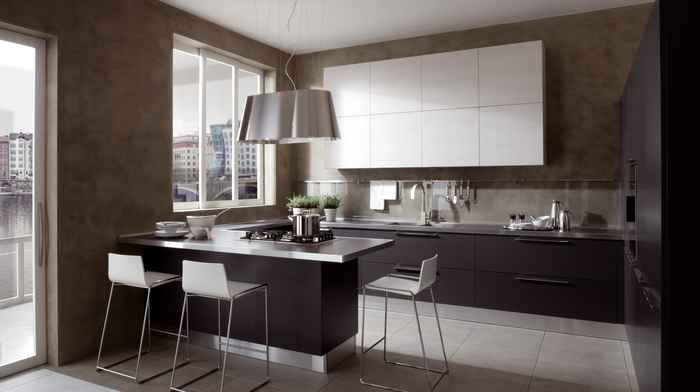
Lighting must not be forgotten. For any kitchen, the best choice is combined lighting. The optimal solution is built‑in LED lighting complemented by a main ceiling chandelier, as well as wall and table lamps. The most interesting kitchen designs always include lighting kits equipped with an additional light line above the work surface.
Today designers develop separate lighting models for each stylistic direction. For example, Provence‑style table lamps often feature fabric‑woven shades; Art Deco interiors suit massive crystal ceiling chandeliers; minimalism and high‑tech prefer sleek, restrained lighting fixtures. Properly selected light makes any kitchen interior cozy, comfortable, and modern.
In contemporary design, shades matter more than colors. The overall background should be pleasant and make you want to stay in the kitchen. It’s best to favor natural tones. Neon colors are no longer mainstream; they can serve only as bright, occasional accents, such as a rim on a flower vase or a lamp shade.
Today, calm pastel tones are most common—soft blue, pale pink, gray shades. Most modern kitchen interiors are softened with bright details. For instance, a kitchen space in brown or muted green looks great with orange elements. Such colorful accents can be a countertop, a set of kitchen towels, curtains, or lighting fixtures.
An interesting solution is using different shades of a single color family. In practice, one color sector can contain around 200 tones of varying saturation.
Modern homeowners demand higher functionality, so practicality comes to the forefront. The simplest way to meet this requirement is open‑type wall‑mounted shelves made from various materials such as glass, wood, plastic, and so on.
These functional interior pieces can store jars with different contents, dishes, and other kitchen items of various sizes and heights. With wall‑mounted shelves you can create a very interesting kitchen design that stands out from the rest. Corner models maximize free space, look unobtrusive, and do not overload the interior. Straight‑line constructions that run along the wall are better suited for elongated rectangular rooms.
Comments