Articles
How to Build a Fence at a Summer Cottage – Step‑by‑Step Guide
Learn how to build a durable, attractive fence for your cottage: material choices, tools, and step‑by‑step construction tips.

Articles
Learn how to build a durable, attractive fence for your cottage: material choices, tools, and step‑by‑step construction tips.
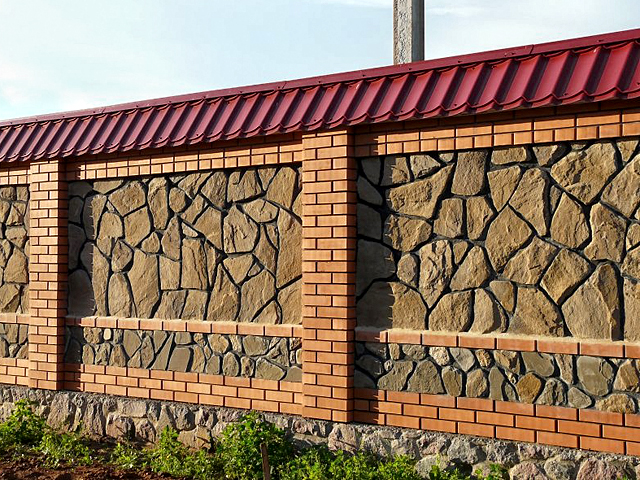
Today many cottage owners often wonder how to install a fence on their plot with their own hands so that it turns out sturdy, beautiful, and fulfills its purpose. Fences are what “mark” a person’s private territory, making it clear to others that entry is prohibited. Therefore, before deciding what material to use, you should determine the level of protection required for your land. The choice of material and the fence’s design depend on this decision.
If the area where your cottage is located is peaceful and you have good relations with the neighbors, there is no need to install a massive barrier. Such fences can effectively hide the plot from strangers’ eyes, but building them yourself is not easy. To build a fence at a cottage with your own hands, you need to study the process in detail.
Having decided why you need a fence, you can start buying the materials required for its construction. First, measure the area where the fence will be placed to calculate precisely how much material you need. After that, you can begin the actual building work.
Support posts are installed first, and their type is easy to determine from the chosen material. For example, when building a brick fence, pipes with a diameter of 100–150 mm are used as supports. For a fence made of profiled sheet metal, 60 mm thick pipes are suitable. You can find these details in a building‑materials store when purchasing the necessary items.
To ensure that a DIY cottage fence is strong, reliable, and safe, pay special attention to the installation of the support structures. They guarantee the long “life” of your fence. Start the procedure with layout, usually done with a cord and stakes. Drive the stakes into the ground where the supports will be placed. Remember that the distance between them depends on the fence’s height and thickness.
After marking, drill holes for the supports. The holes must be at least as deep as the frost line in your soil. If you are building a wooden fence and want it to be durable, treat the wood beforehand with a special antiseptic solution to reduce rot.
To keep all supports in a single, straight line, use a cord and a plumb line. Set the first and last posts vertically with the plumb line, then place the remaining supports and check the level with a sighting tool. Usually you stand so that the nearest post completely hides the far one; if you find such a point, the alignment is correct. If not, re‑check the positioning of the posts.
When the supports are precisely positioned, move on to fixing them. Fill the excavated pits with a mixture of crushed stone and sand and compact it well. For a stronger foundation, you can pour concrete into the pits, adding broken bricks or crushed stone to the mix.
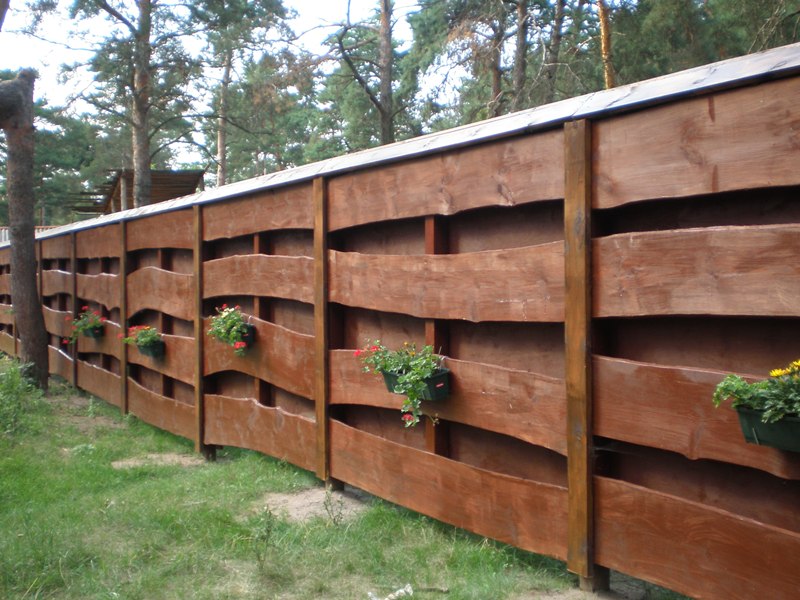
Today, wooden fences are perhaps the most popular choice. Common models include picket fences, “ranch” style fences, and woven (wattle) fences. If you want to build such a structure yourself, this type is recommended because its assembly is relatively simple. Before building a fence at a cottage, study the process for each listed type in detail.
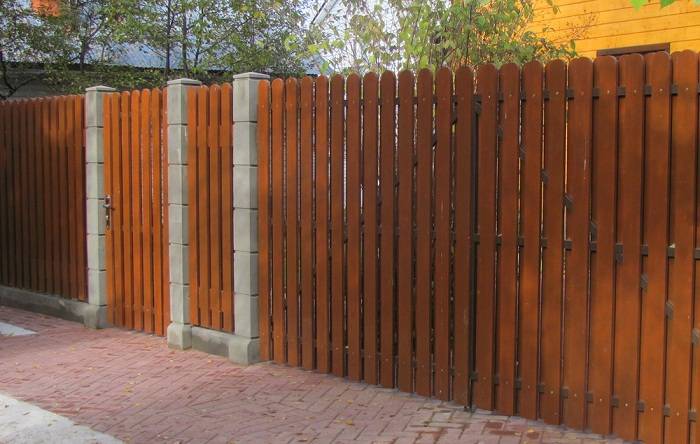
Picket fencing is the most economical and widespread material, perfect for a cottage enclosure. It is easy to install yourself without specialist help. You can give it any shape and configuration, depending on the owners’ preferences and budget. The construction method is simple: two wooden beams are attached to each support post, leaving a 20 cm gap from the ground and from the top of the posts. Fasten the beams to the posts with self‑tapping screws. Horizontal wooden planks are then attached to the beams using nails or screws. Straight, planed boards are often used because they give the fence a more presentable appearance.
When fixing the planks, keep a uniform spacing between them or place them edge‑to‑edge. The main rule is that all boards must be on the same level. To achieve this, stretch a cord over the support posts and align the ends of the pickets along it. Also, avoid letting the boards touch the ground, as they will rot quickly.
Wattle fences are less common than picket fences, so they are chosen less often. Their installation requires more time, effort, and money because additional support posts are needed. Building a fence yourself at a cottage will require some time, effort, materials, tools, and patience, as not every owner can master the task immediately. Regardless of the construction you choose, the important thing is to build it with care and the craftsmanship that belongs to a true handyman.
Comments