Articles
How to Properly Pour a Foundation
Learn the correct steps to pour a foundation so your building lasts for years. From site layout to reinforcement and concrete pouring.

Articles
Learn the correct steps to pour a foundation so your building lasts for years. From site layout to reinforcement and concrete pouring.
In residential construction, strip foundations are the most common type of support, so every builder must know how to pour a foundation correctly and quickly. This design has a low cost, performs its functions well, and is easy to build, but it cannot be used on shifting soils. In such cases, builders usually opt for a pile foundation. Regardless of the chosen type, before starting work you need to accurately calculate the required material quantities, purchase them, and transport them to the building site. It is advisable to buy the full volume of materials in advance so that nothing distracts you during the work.
It is also important to prepare the building plot properly. You will need to mark the boundaries of the future structure, taking into account factors such as the footprint of the planned house, its weight, groundwater level, terrain relief, and others. Wooden stakes are driven along the perimeter of the future building and along internal partitions, and strings are stretched between them. To verify the perpendicularity of the marked lines, compare the diagonals of the trench corners. When the diagonals are equal, all angles are perfectly right.
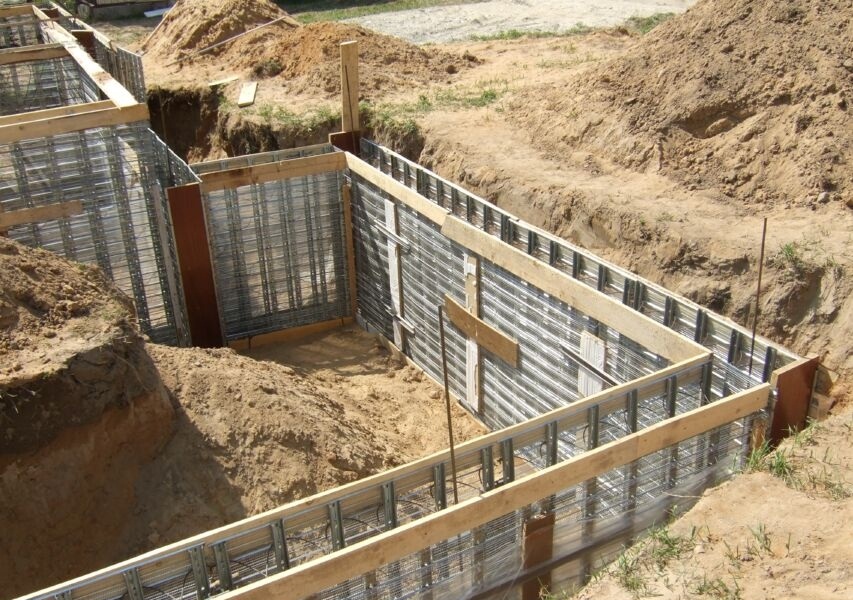
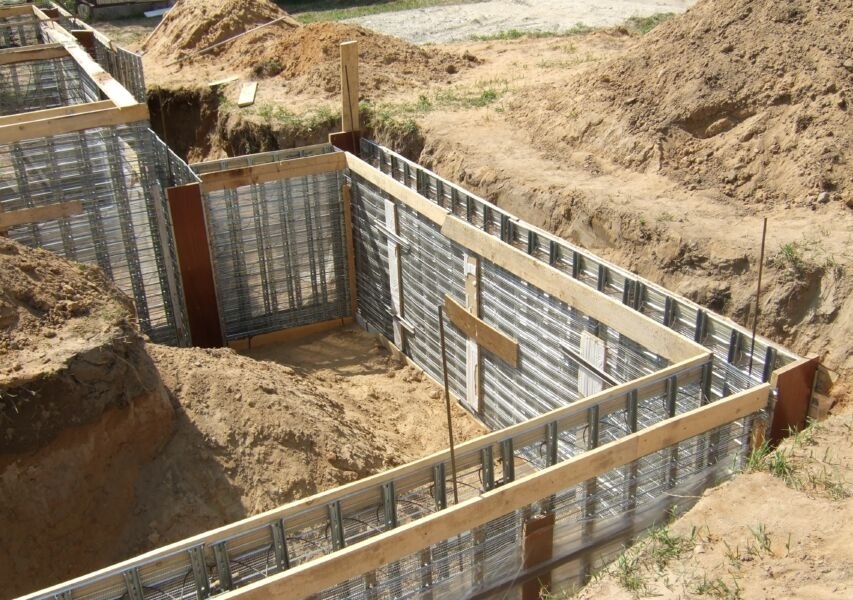
The next stage is excavating the trench intended for a strip foundation or drilling boreholes for piles. The quality of these works directly affects the future building’s durability. The trench walls are reinforced with boards that form a reliable formwork. Other materials can be used, but boards are preferred because they are inexpensive and easy to handle.
The trench bottom is placed below the frost depth. An optimal difference between these levels is about twenty‑to‑thirty centimeters. When calculating borehole depth, soil density must also be considered. Usually, a two‑meter deep hole is sufficient. If the foundation will be a strip type, a sand cushion should be laid at the bottom of the trench. This is simple: spread a fifteen‑centimeter layer of sand, wet it, and then compact it. A waterproofing membrane is laid over the sand.
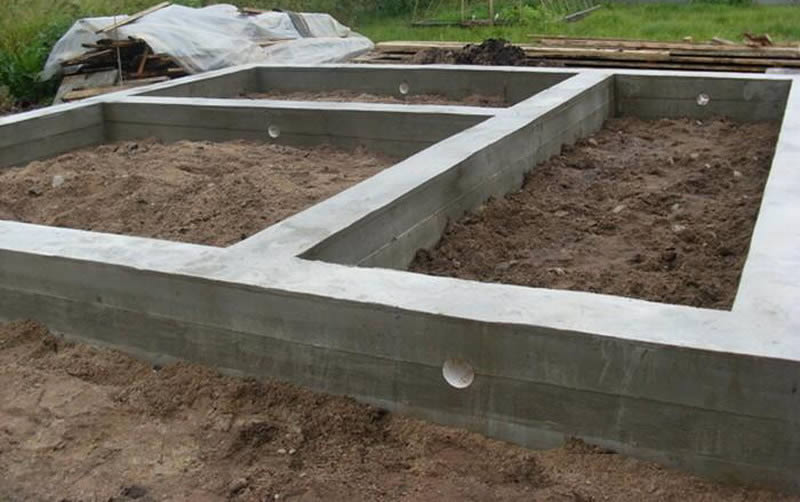
Before building a foundation yourself, understand that the structure will bear significant loads, so cement paste alone is not enough. For the concrete base to be strong, reliable, and to perform its functions well, it must be reinforced.
Reinforcing a pile foundation is much simpler: several steel rebars are placed inside the borehole before pouring. For a strip foundation, a more complex arrangement of vertically placed rebars must be welded together. The spacing between parallel reinforcement elements must not exceed forty centimeters. To keep the steel bars from shifting, the worker ties them with thick steel wire or welds them together.
Concrete mix should be prepared right before use. In advance, decide on the materials for the mix and arrange rental of the necessary equipment. The standard recipe is a 1:3 ratio—one part cement to three parts sand, cleaned of debris. The resulting mixture is then combined with five parts of small‑size gravel.
Pouring must be carried out uniformly around the pile installed in the borehole or along the entire perimeter of the trench prepared for a strip foundation. Using a long metal rod, periodically poke the freshly poured mix to eliminate air pockets. After the pour is complete, the concrete should be further compacted. This can be done with a vibrating plate or a similar device.
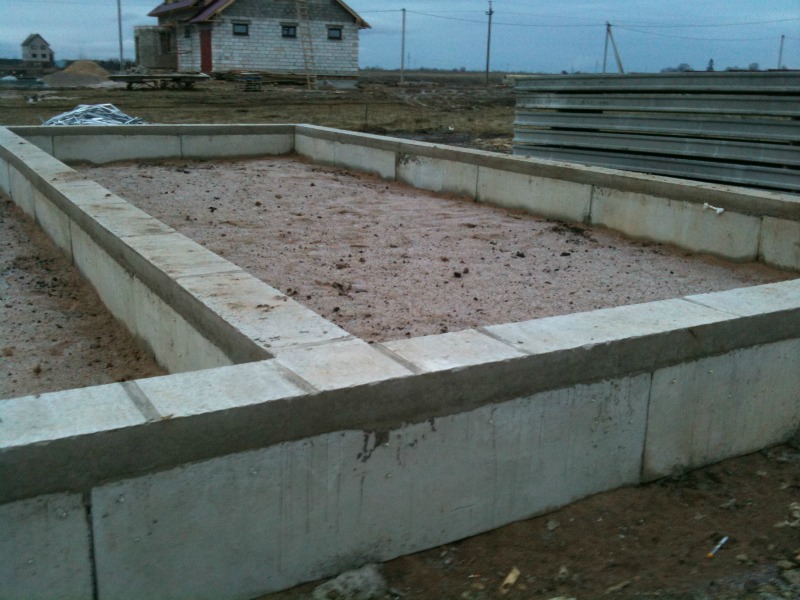
Afterward, the concrete needs a curing period, so you cannot start building walls immediately after the foundation work. The main factor influencing the waiting time is ambient temperature. In summer, a concrete foundation typically reaches sufficient strength in about four weeks. If all procedures are followed step by step according to the recommendations, the foundation will serve for many years without the need for repairs.
Comments