Articles
Which Roof Should You Choose for Your Home?
Learn the differences between flat, pitched, and special roof types, their advantages and drawbacks, and when each is appropriate for your house.

Articles
Learn the differences between flat, pitched, and special roof types, their advantages and drawbacks, and when each is appropriate for your house.
One of the most significant elements in construction is the roof of a house, which carries a multitude of functions, including maintaining the overall attractiveness of the building and protecting it from external factors. The type of roofing is determined not only by aesthetics. The correctly chosen roof type must be defined by calculating loads on each part of the overall structure. The choice also depends on the building’s type and size.
One of the most significant elements in construction is the roof of a house, which carries a multitude of functions, including maintaining the overall attractiveness of the building and protecting it from external factors. The type of roofing is determined not only by aesthetics. The correctly chosen roof type must be defined by calculating loads on each part of the overall structure. The choice also depends on the building’s type and size.
There is a generally accepted classification of roofs based on the slope angle of the structure. A roof is considered flat when its angle relative to the horizon is two or three degrees. It should be noted that this type is rarely used for covering private houses or cottages. Flat roofs are most common on high‑rise buildings. This is explained by the difficulty of maintaining the structure due to atmospheric precipitation. After rain, a large amount of water collects on a flat roof, and in winter a lot of snow accumulates, which must be cleared manually. However, there are positive aspects as well. For example, this design is considered the most budget‑friendly.
The most popular roof type for a house is the pitched roof, which exists in several variants. Today there are countless design options with roof slopes starting from ten degrees. Regardless of the season, such roofs do not retain precipitation; meltwater and rain flow down through dedicated drainage systems.
Today several models of pitched roofing are distinguished. Each has its own advantages and disadvantages and is further divided into sub‑types. To choose a specific roof design for a private house, you should become familiar with each of them:
It should also be noted that four‑slope roofs are rare today. Most owners of country properties choose single‑ or double‑slope designs, which require fewer expenses and handle all atmospheric precipitation efficiently.
There are also several roof designs that are encountered quite rarely. For example, a pavilion roof consists of four equal triangles that meet at the top point. This type is suitable only for buildings with a square plan. The roof looks striking, but its installation requires a special rafter system, which is not within the capabilities of every builder.
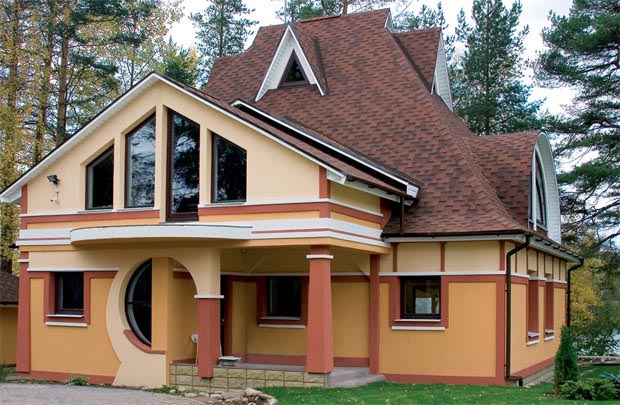
A complex variant is the multi‑gable roof, also called an “end roof.” Its main feature is the multitude of internal angles and external ribs located at the junctions of the slopes. Building such a structure on your own is impossible. This variant is well suited for polygon‑shaped houses with additional extensions, such as side mansard wings.
Even rarer is the dome roof, which requires assembling a frame from curved components. Soft materials like roofing felt or bitumen tiles, as well as flexible steel or plastic tiles, are used for its construction. Today, spherical roofs are also popular, often used for gazebos, churches, or stadiums.
One of the most refined options is the green roof. This eco‑friendly covering consists of natural soil with living vegetation. It is usually installed as a flat roof. Its installation demands a special ventilation layer that limits root growth and ensures water drainage. This design is increasingly common in the United States, but it is hard to call it convenient. The labor‑intensive maintenance does not justify the costs.
Considering all the listed features, you can select a roof for your house, but you should take into account not only personal taste but also the technical characteristics of the building for which the roof is being chosen. Builders who perform all construction work themselves should prefer simpler modifications. Only with the right approach can you make a truly correct choice that you won’t regret over time.
Comments